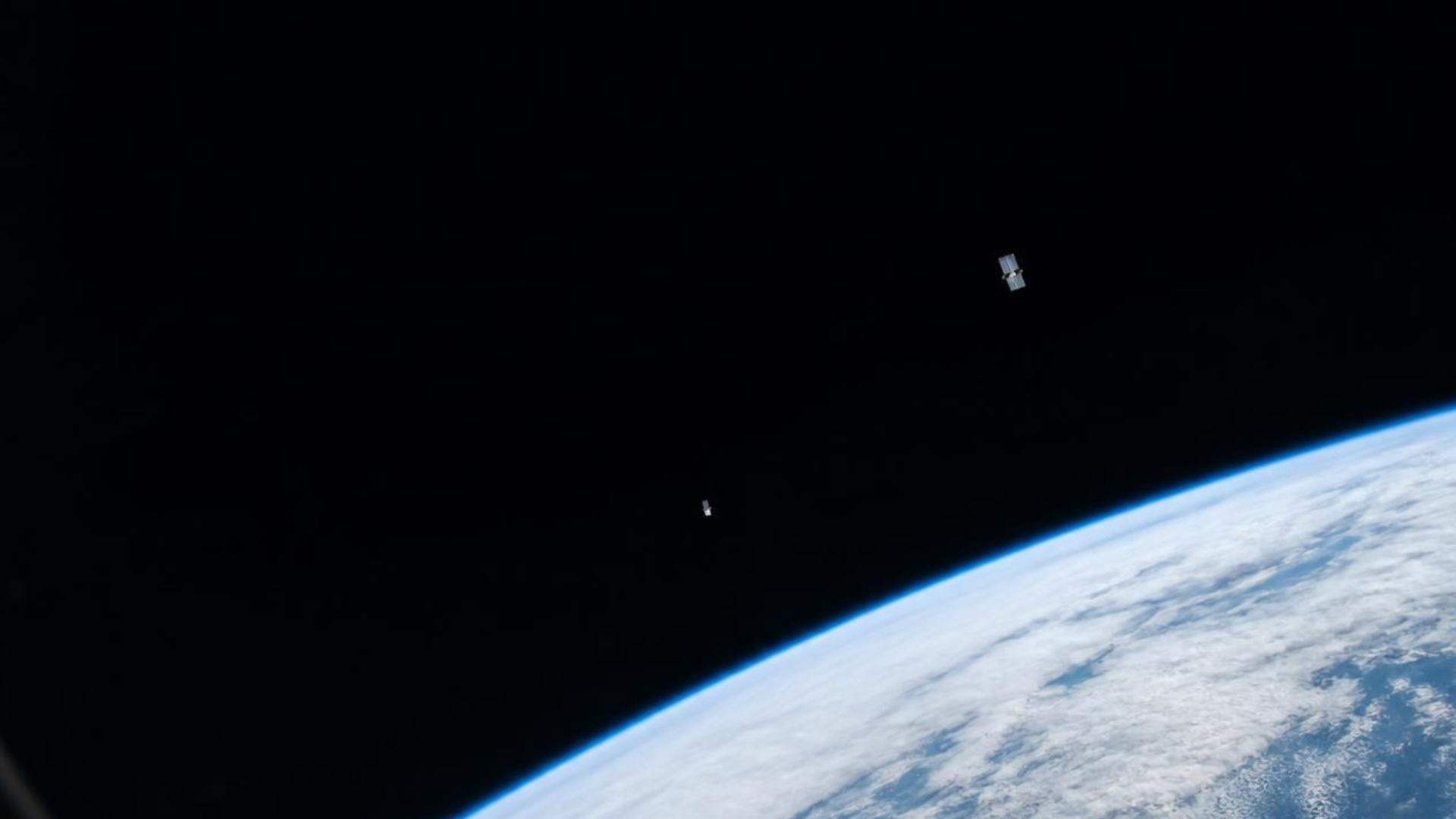
Image: Artist’s rendering of the three missions launched together in 2025: on the left NASA’s Carruthers Geocorona (CGO) observatory studying the Earth’s exosphere, in the center the IMAP probe mapping the heliosphere, and on the right NOAA’s SWFO-L1 satellite monitoring the Sun from the L1 point (Credit: NASA).
What is IMAP and what does it research?
The Interstellar Mapping and Acceleration Probe (IMAP) is a NASA heliophysics mission, launched on September 24, 2025, designed to study the far reaches of the heliosphere – the magnetic bubble generated by the solar wind that envelops the Solar System – and understand how charged particles are accelerated in space[1][2].
He acts as a modern “celestial cartographer”, mapping the boundaries of that heliospheric bubble and investigating two fundamental scientific questions:
1. How charged particles from the Sun are energized (giving rise to the solar wind)
2. How this solar wind interacts with the local interstellar medium at the heliosphere boundary[3][4].
In essence, the probe seeks to unveil the processes by which the Sun influences its galactic environment and how the heliosphere protects planets from cosmic radiation from the outside[5][6].
In addition to its basic studies, IMAP also supports real-time observations of the solar wind, contributing to the early warning of space weather phenomena that could affect Earth[7].
On the applied level, IMAP and its companion missions (CGO and SWFO-L1) significantly strengthen our ability to forecast space weather. IMAP is stationed at the L1 Sun-Earth Lagrange point, about 1.5 million km from Earth looking towards the Sun. From this vantage point, IMAP monitors in real time the flux of particles and radiation emitted by the Sun.
The spacecraft has a fast transmission system called I-ALiRT that broadcasts near-instantaneous data from the solar wind and energetic particles measured by its instruments[40][41]. This continuous transmission provides valuable information about 30 minutes in advance about solar radiation storms or interplanetary shocks heading for Earth[42]. For example, in the event of an extreme solar explosion, IMAP could detect the arrival of energetic protons and alert satellite controllers and space crews half an hour in advance, helping them to take protective measures (NASA, 2025).
In parallel, NOAA’s SWFO-L1 satellite, located at the same L1 point, operationally observes the solar corona and measures the upstream solar wind. SWFO-L1 carries a coronagraph (CCOR-2) to detect ongoing coronal mass ejections (CMEs), providing 1–3 days’ advance warnings of geomagnetic storms toward Earth (NOAA, 2025)[43][44]. In addition, its solar wind sensors (plasma, magnetometer, and suprathermal ion) continuously feed NOAA’s Space Weather Prediction Center models, improving the accuracy of forecasts of auroras, ionosphere disturbances, and induced currents in the power grid[45] .
Importance of IMAP for Space Weather Science and Prediction
The mission has a high scientific impact on heliophysics and astrophysics, while bringing practical benefits for space weather forecasting. On the fundamental scientific level, it will allow a better understanding of how the Solar System interacts with the galaxy. By drawing unprecedented maps of the heliosphere – its boundaries, composition and dynamics – IMAP will fill gaps in our knowledge of how the solar wind and solar magnetic field create a habitable zone protected from cosmic radiation[5][6]. This heliospheric “bubble” is essential for life on Earth, as it blocks part of the galactic cosmic rays; Therefore, understanding how they work has direct implications for planetary sciences and the search for habitability in other star systems.
It will also study in situ the processes of particle acceleration that occur throughout the Universe (in supernova collisions, stellar winds, planetary magnetospheres, etc.), using our space neighborhood as a laboratory. The IMAP data will help unravel the physics behind phenomena such as solar cosmic rays, the formation of “suprathermal” particles, and the structure of shocks and waves in astrophysical plasmas[12][38].
In sum, IMAP’s findings will contribute to the fundamental physics of plasmas and energetic particles, with applications ranging from improving models of the interstellar medium to a better understanding of the cosmic “building blocks” of the Universe[39] [46].
Together, IMAP + SWFO-L1 provide a complementary monitoring system: IMAP provides scientific insight and high-resolution data (e.g. particle spectra, energetic neutral atoms) and SWFO-L1 provides 24/7 operational monitoring of solar conditions and incident solar wind.
This synergy will allow for improved space weather models, providing more reliable forecasts of potentially harmful solar events[47][48]. Protecting our society’s technological infrastructure – communication and navigation satellites, power grids, polar aviation systems, etc. – critically depends on those early warnings of space weather (Taalat, 2023).
With its advanced instruments, it will enrich our predictive capacity by clarifying the origins and evolution of solar disturbances from their gestation on the Sun to their impact on Earth. In addition, IMAP’s real-time data will be valuable for manned Artemis missions to the Moon and future missions to Mars, by acting as a radiation sensor that warns astronauts of dangerous increases in energetic solar particles (Fox, 2025)[49].
Institutional and instrument actors
The mission is an international collaborative effort led by NASA in partnership with academic institutions and research centers. The principal investigator (PI) of IMAP is Dr. David J. McComas of Princeton University (USA), selected by NASA to lead the science team since 2018[17][18]; assigning project management to the Johns Hopkins University Applied Physics Laboratory (JHU/APL) in Maryland, which was tasked with designing and building the spacecraft and also leads mission operations (Johns Hopkins APL, 2020)[19][18]. Likewise, NASA’s Solar Terrestrial Survey (STP) Program – managed by NASA’s Goddard Space Facility – oversees this mission within its scientific portfolio (Brown, 2018; Johns Hopkins APL, 2020)[20][18].
It has 10 scientific instruments on board, developed by a consortium of 25+ institutions from the United States and other countries (Imperial College London, 2024)[21][22]. Notably, eight of the instruments were built in the US, one in the UK, and one in Poland (Dunning, 2024)[23], reflecting the international nature of the project.
Each of these instruments provides complementary measurements, which together provide a comprehensive picture of particles and fields in the interplanetary environment[29][30]. The IMAP Payload Office, managed by Southwest Research Institute, coordinated the integrated development of all associated instruments and subsystems (SwRI, 2025)[31][29]. This multidisciplinary and international collaboration is key to achieving the mission’s ambitious scientific objectives.
Costs and Interagency Collaboration (NASA-NOAA-CGO)
The IMAP mission was selected under a limited cost scheme. NASA originally set a maximum budget of approximately $564 million for the development phase of IMAP (not including the launch vehicle).[32] During the design phase, complete life-cycle cost estimates, including the launch rocket and reserves, were around $700–770 million according to independent assessments in 2020 (GAO, 2020)[33]. Finally, NASA invested around $700 million in the realization of IMAP, a figure that covers the construction of the spacecraft, the scientific instruments and its launch into orbit. This amount places IMAP within the agency’s medium-class heliophysics missions, reflecting the technical complexity of taking ten state-of-the-art instruments into deep space.
As for NOAA’s input, the U.S. National Oceanic and Atmospheric Administration developed the Space Weather Follow-On SWFO-L1 satellite as an operational space weather monitoring mission that accompanied IMAP at launch. NOAA made a similar investment in magnitude, with a programmed cost of close to $700 million for the full life cycle of SWFO-L1 (including development, operations until 2029, etc.), according to official reports[34].
Importantly, NOAA, flying as a secondary payload alongside IMAP, did not have to bear the launch costs of SWFO-L1: NASA fully funded the Falcon 9 rocket and launch services as part of the IMAP project[35].
The rideshare joint launch arrangement benefited both agencies by reducing costs – NOAA avoided paying for a dedicated launcher, and NASA optimized the rocket’s capacity to carry SWFO-L1 and the small CGO observatory as well. It is estimated that the shared launch of the three satellites had a total cost of approximately USD$109 million to NASA, a fraction of the cost that separate launches would have had (NASA Launch Services Program, 2025). This interagency collaboration exemplifies an efficient model: NASA and NOAA joined forces to simultaneously deploy a science mission (IMAP) and two operational missions (NOAA’s SWFO-L1 and NASA’s CGO observatory)[36][37], maximizing the scientific and socioeconomic return per dollar invested.
In conclusion, IMAP, and its two mission partners, represents a key mission for both basic science and society. On the one hand, it extends the legacy of previous heliospheric explorers (such as Voyager 1/2 and IBEX), taking us one step further on the map of nearby interstellar space. On the other hand, their contributions will improve resilience in the face of space weather, an issue of increasing importance as our dependence on orbital technology and aspirations for human exploration beyond Earth continue to increase. IMAP exemplifies how an academic mission to explore the Solar System can, at the same time, produce novel knowledge about our place in the Universe and provide practical tools to safeguard technological civilization on our planet.
References
- Angus, T., & Dunning, H. (2024, February 20). Imperial-built instrument jets off to NASA ahead of major solar wind mission. Imperial College London News. Retrieved from Imperial.ac.uk[21][22]
- Brown, D. C. (2018, June 1). NASA Selects Mission to Study Solar Wind Boundary of Outer Solar System [Press Release]. Fish trap. Retrieved from NASA.gov[20][50]
- Johns Hopkins Applied Physics Laboratory. (2020, January 28). NASA’s Interstellar Mapping and Acceleration Probe Mission Enters Design Phase [Press Release]. JHU/APL. Retrieved from jhuapl.edu [32][18]
- McComas, D. J., et al. (2018). Interstellar Mapping and Acceleration Probe (IMAP): A New NASA Mission. Space Science Reviews, 214(116). https://doi.org/10.1007/s11214-018-0550-1
- NASA Science. (2025). Interstellar Mapping and Acceleration Probe (IMAP) – Mission Overview. NASA Heliophysics Missions. Retrieved from science.nasa.gov [7][6]
- Niles-Carnes, E. (2025, September 24). Signal Acquired for Space Weather Spacecraft. NASA IMAP Blog. Retrieved from science.nasa.gov [35][51]
- NOAA/NESDIS. (2023). Report to Congress: Space Weather Follow-On (SWFO) Program Baseline. National Oceanic and Atmospheric Administration. Retrieved from nesdis.noaa.gov [34]
- Southwest Research Institute (SwRI). (2025, September 22). SwRI managed the IMAP payload set to launch this month to map the boundary of the heliosphere [Press release]. Retrieved from swri.org [31][29]
- SpaceX/NASA. (2025, September 24). IMAP Mission Launch Broadcast. NASA TV/Launch Services Program (launch cost sharing data cited during broadcast).
- Wall, M. (2025, September 24). SpaceX launches 3 probes to study space weather and map the boundaries of our solar system. Space.com. Retrieved from space.com [52][53]
- [1] [2] [3] [4] [5] [6] [7] [9] [11] [13] [15] [16] [39] [40] [41] [42] [47] Interstellar Mapping and Acceleration Probe (IMAP)
- [18] [19] [32] NASA’s Interstellar Mapping and Acceleration Probe Mission Enters Design Phase | Johns Hopkins University Applied Physics Laboratory
- [21] [22] [23] [38] Imperial-built instrument jets off to NASA ahead of major solar wind mission | Imperial News | Imperial College London
- [24] [25] [28] IMAP Leadership | Interstellar Mapping and Acceleration Probe (IMAP) mission at Princeton
- [26] [27] [29] [30] [31] SwRI managed the IMAP payload set to launch this month to map the boundary of the heliosphere | Southwest Research Institute
- [33] GAO-20-405, NASA: Assessments of Major Projects
- [34] nesdis.noaa.gov
- [43] [44] [45] [46] SWFO-L1 Launch | NESDIS | National Environmental Satellite, Data, and Information Service