When the market rallies for the right reasons and those very reasons are its greatest risk.
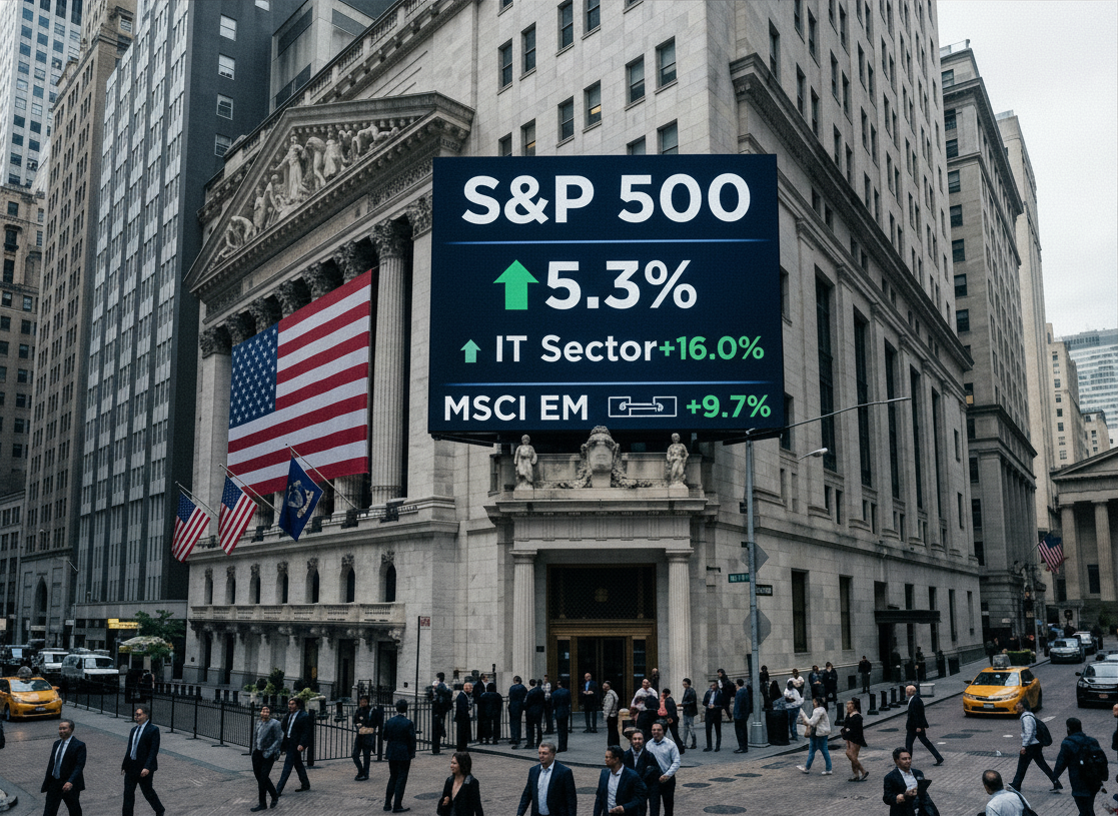
This week, markets handed us the sharpest picture we have seen in years of what happens when a bullish narrative and genuine fundamentals feed off each other until the two become indistinguishable. The S&P 500 broke through 7,600 for the first time in history, logged its 24th record close of the year, and strung together nine consecutive weeks of gains — the longest winning streak since May 2025. And it pulled all of that off, worth noting, while Iran was mining the Strait of Hormuz and diplomatic back-channels with Tehran remained wide open.
The engine behind the move was, once again, artificial intelligence. Nvidia surged 6.2% after Jensen Huang took the stage at Computex 2026 in Taipei to unveil the RTX Spark chip, a move that dragged Dell up 10% and Microsoft up 2% in its wake, firmly cementing Huang as the single most consequential voice driving global equity markets. Nearly in parallel, Alphabet announced the largest equity raise in the history of the technology sector — $84.75B in total —, with Berkshire Hathaway stepping in as a $10B private-placement anchor, all of it justified by a statement that captures this moment better than any research note: demand for Alphabet’s AI services is currently running ahead of its available compute capacity (SEC Filing, 2026; CNBC, 2026).
Out of this collision of signals emerges the paradox that runs through everything that follows: the market is rallying because AI is real, because the earnings are real, and because the demand is structural. But it is rallying in a way that has quietly rendered the concept of the ‘broad market’ operationally meaningless. Semiconductors now account for 18% of the S&P 500 — more than twice the peak exposure the sector reached at the height of the dot-com bubble — and Capital Economics estimates the index would be trading 25% lower if the AI tailwind were stripped out. At the same time, J.P. Morgan puts the probability of a ‘concentration collapse’ scenario before year-end at 35%.
In other words: today’s good news is also tomorrow’s primary risk factor. This article unpacks exactly what is happening, why it matters, and how an investor can position intelligently in the face of that tension.
The Facts: What happened this week
The week of June 2, 2026 delivered a sequence of events that, taken individually, would each have warranted a front-page headline. Taken together, they paint the most complete picture we have had in a long time of a market that AI no longer merely leads — it defines.
Computex 2026, Taipei. Jensen Huang stepped onto the stage at Asia’s largest technology event and launched the RTX Spark, the first NVIDIA processor purpose-built to run AI inference natively on Windows PCs, eliminating the data center dependency. The market responded immediately: shares jumped 6.3% in that same session, pushing NVIDIA’s market capitalization to approximately $5.43 trillion — a figure that eclipses the entire GDP of Japan (CNBC, 2026a). And as if that were not enough, Huang also endorsed Marvell Technology from the stage, calling it ‘the next trillion-dollar company,’ a remark that single-handedly catalyzed a 32% single-session rally in the stock (TheStreet, 2026).
On June 1, Alphabet launched an $80B equity offering that was upsized the following day, ultimately pricing at $84.75B — comprising $30B in underwritten public offerings, a $40B at-the-market program, and a $10B private placement anchored by Berkshire Hathaway (SEC Filing, 2026). What makes this move particularly telling is that the company was already sitting on more than $90B in cash before the announcement. If a business with that kind of balance sheet is nonetheless tapping the equity market, the only reasonable read is that the opportunity cost of not building infrastructure fast enough outweighs the dilution to shareholders. In Alphabet’s own words: ‘demand for our AI solutions and services from enterprises and consumers is currently exceeding our available supply.’
Perhaps the most consequential detail of the entire week is not the size of the raise, but who is sitting across the table. Warren Buffett had systematically steered clear of technology for decades, guided by his well-known principle of not allocating capital to what he does not fully understand. Against that backdrop, the fact that Berkshire’s Alphabet stake has now crossed $30B and continues to build (Bloomberg, 2026) is not a footnote — it is a statement of conviction. When the most risk-averse allocator in the history of modern capitalism throws his weight behind the AI infrastructure race, the signal to the rest of the market is unambiguous.
“Goldman Sachs raises its S&P target to 8,000.” That is not a headline to be glossed over. The bank is projecting index EPS of $340 for 2026 and $385 for 2027, underpinned by an earnings growth outlook in which AI accounts for roughly 40% of the total incremental gain (UnboxFuture, 2026). An 8,000 target implies an additional 5.3% upside from current levels — which, in the market vernacular of June 2026, amounts to saying the runway is still long.
While all of this was unfolding, U.S. Secretary of State Marco Rubio was confirming that Iran has mined ‘large segments’ of the Strait of Hormuz the chokepoint through which roughly 20% of the world’s oil supply flows. Crude oil ticked up. Equities ticked up too. That coexistence of a deepening geopolitical crisis in the Persian Gulf with the S&P 500 printing all-time highs is not a sign of irrationality — it reflects a clear and deliberate repricing of risk hierarchies: investors, right now, are betting that AI carries more weight than oil.
The Dashboard: What the numbers are telling us
| Indicator | Current level | Benchmark | Investment read |
| S&P 500 — record close | 7,617 pts (Jun. 2026) | Year-end 2025: ~5,900 | 24th all-time high of the year. Nine consecutive weeks of gains — the longest winning streak since May 2025. |
| Nvidia — S&P 500 index weight | 7% | Apple: 6.3% | The most index-influential chipmaker in history. Has overtaken Apple and Microsoft for the top spot. |
| Semiconductors in S&P 500 | 18% | Tech-bubble 2000 peak: <9% | More than double the sector’s all-time high during the dot-com peak. Cameron Dawson, NewEdge Wealth. |
| Tech + AI in S&P 500 | 45% of market cap | 2010: 15–18% | Capital Economics estimates the index would trade 25% lower absent the AI tailwind. |
| Alphabet — equity raise | $84.75B (upsized) | Largest tech capital raise | Berkshire anchors $10B. Demand is currently outpacing the company’s available compute supply. |
| Marvell Technology (MRVL) | +32% in a single session | Jensen Huang at Computex | Huang called it ‘the next trillion-dollar company.’ |
| Goldman Sachs — S&P target | 8,000 pts (year-end 2026) | Previous: 6,500 | 2026E EPS: $340. 2027E EPS: $385. AI accounts for ~40% of total index earnings growth. |
| Fed funds rate | 3.50–3.75% | Cycle peak: 5.5% | The Fed is on hold. No rate cuts are imminent. The short end of the curve remains inverted. |
Table 1. Market signal dashboard — VenQuest Group (June 2026). Compiled from CNBC, SEC, Goldman Sachs, J.P. Morgan, Capital Economics.
The structural paradox: A rally that is its own greatest risk
Few moments in recent market history lay out the investor’s dilemma with this degree of clarity. The S&P 500 is at all-time highs, earnings are holding up, and AI demand is structural. And yet, precisely because all of that is true, the architecture of this rally is quietly building up the most significant systemic risk the market has accumulated in decades.

To grasp the full scale of what is happening, it helps to start with a comparison that has no historical precedent. A decade ago, semiconductors accounted for 2% of the S&P 500. Today they account for 18% — more than double the peak exposure the sector ever reached during the technology bubble of 2000 (247WallSt, 2026). Put differently: the market is more heavily concentrated in semiconductors right now than it was at its most euphoric moment in living memory.
Layer on top of that the fact that technology as a broad sector is running near 37% of the index (Cambridge Associates, 2026), and that the top five names by index weight — Nvidia, Apple, Microsoft, Alphabet, Amazon — collectively hold around 30% of a benchmark that is supposed to represent 500 companies drawn from the most diversified economy on earth, and the picture becomes hard to dismiss.
Cameron Dawson, CIO at NewEdge Wealth, put it with surgical precision: ‘concentrated AI capex spending on chip infrastructure has made traditional diversification across style boxes and geographies ineffective’ (247WallSt, 2026). The practical implication is that buying an S&P 500 ETF today does not mean buying ‘the market.’ It means, in large part, making a concentrated bet on the AI infrastructure capex cycle. An investor who believes they are well diversified because they hold 500 names may be in for a rude awakening when they realize how much of their book ultimately hinges on Nvidia’s next earnings call.
On the other hand, Dubravko Lakos-Bujas, global head of markets strategy at J.P. Morgan, did not mince words: the market has moved into a regime where ‘a single earnings miss or a shift in AI sentiment among the top 20 stocks could trigger a deleveraging event capable of dragging down the entire index, regardless of the health of the other 480 components’ (J.P. Morgan, 2026). The probability the bank assigns to that scenario materializing before the end of 2026 is 35%. That is not a tail risk — it is a scenario with higher odds than many events markets routinely price in.
And yet, here is where the most uncomfortable part of the current cycle comes into focus: this concentration did not grow out of irrationality, but out of fundamentals. Nvidia is genuinely generating $62.3B in quarterly data center revenue. Google Cloud grew 63% year-over-year. Broadcom reported AI revenue of $6.2B in a single quarter, up 74% on the year (Broadcom Q4 2025). The numbers back the narrative. The problem, then, is not that the rally is wrong — it is that when a fundamentally sound rally becomes the only story the market knows how to tell, the correction that eventually follows will reach investors who never even realized they had that much exposure to begin with.
The Investment Playbook: Opportunities and Risks
Given all of the above, the June 2026 environment demands that private investors operate on two layers simultaneously: the tactical layer, which captures the real momentum of a cycle with solid earnings underpinnings; and the strategic layer, which builds in the resilience needed to weather the concentration risk that the same rally has been quietly accumulating. Working exclusively off one layer or the other means either sitting out the most significant market opportunity of the decade, or being caught flat-footed when the correction comes.
The Tactical Layer:
| Opportunities backed by fundamentals | Risks the price is underplaying |
| Earnings-driven rally: Nvidia up 1,180% from Jan 2023, underpinned by $62.3B quarterly data center revenue — this is not hollow speculation. | Systemic concentration: a selloff in just 3–4 top AI names could drag the entire index lower, regardless of the health of the other 480 components (J.P. Morgan, 2026). |
| Alphabet’s $84.75B equity raise: a direct signal that structural demand is outpacing supply — the market is willing to fund one of the most cash-rich companies in the world to keep building. | Unproven monetization: Goldman Sachs flags the risk of a ‘metaverse moment’ for hyperscalers — $1.3 trillion in combined capex with the economic return still not fully visible (J.P. Morgan Eye on the Market, 2026). |
| Berkshire backs the sector: Buffett — the investor who systematically steered clear of tech for decades — has built a $30B+ stake in Alphabet. The most powerful value-capital endorsement of the AI cycle. | Twin geopolitical tail risk: Iran has mined segments of the Strait of Hormuz (Sec. Rubio, Jun. 2026) while Taiwan remains the sole source of advanced chip manufacturing on the planet. |
| Broadcom’s supply-chain play: custom ASICs for Google, Meta, and Apple — a business line structurally decoupled from the GPU cycle that grew 74% YoY in the most recent quarter. | Stretched valuations leaving no margin for error: the S&P 500 trades at ~22x forward P/E against a long-run average of 16x — any guidance miss from a hyperscaler could compress multiples 15–20%. |
| ISM Manufacturing at 54: the real economy is also picking up — new orders at 56.8, employment improving. This rally is not purely a paper story. | Bitcoin diverging: non-specialized risk assets are being unwound ($2.43B in BTC spot ETF outflows in May). The market is concentrating its bets, not spreading them. |
Table 2. Opportunity and risk map — AI Rally, June 2026. VenQuest Group analysis.
The RTX Spark opens a genuinely new addressable market: on-device AI inference, no longer tethered to the data center. That effectively turns every Windows PC into a potential NVIDIA customer, meaningfully expanding the total addressable market. That said, with roughly 7% index weight and a P/E above 40x, any investor who already holds the S&P 500 is carrying indirect Nvidia exposure without necessarily realizing it. Before adding a direct position, the right question is whether total exposure — direct plus index — has already crept above 10–12% of the portfolio. If it has, what looks like diversification is really single-name risk in disguise.
On the other hand, Huang’s endorsement of Marvell at Computex was more than collegial praise — it was a public roadmap declaration. Marvell manufactures the custom ASICs for both Amazon and Microsoft; its revenue model is therefore structurally decoupled from NVIDIA’s GPU cycle and tied instead to hyperscaler demand for bespoke silicon. If the ‘next trillion-dollar company’ thesis has legs, Marvell is currently trading at a meaningful discount to that scenario. High-conviction, certainly — but also high-risk, which is precisely why position sizing matters so much here.
Issuing $84.75B in shares is dilutive in the near term, and the market has a well-established tendency to mark down equity issuers in the weeks following a capital raise announcement. That selloff is exactly where the opportunity lies for the long-duration investor: the reason behind Alphabet’s raise — compute supply unable to keep up with demand — is structurally bullish. Google Cloud printing $20B per quarter at 63% year-over-year growth, with Berkshire providing long-run institutional validation, is a thesis that becomes difficult to argue against once the dilution noise fades out.
Finally, for investors who want exposure to the AI cycle without concentrating in any single name, semiconductor ETFs offer the full value chain in one vehicle: Nvidia, TSMC, Broadcom, ASML, AMD, Micron. SOXX has compounded 330% since January 2023 — the track record speaks for itself. The caveat, however, is that in a sector-wide selloff there is nowhere to hide within the ETF — every component gets marked down together. It functions as diversification within the cycle, not protection from it.
The Strategic Layer: building resilience without exiting the cycle
Concentration hedge. For any portfolio where tech and AI exposure has drifted above 40%, a 5–8% gold allocation provides the most robust hedge available in the current environment — in part because it is the only asset that holds up across all three plausible outcomes: a continuation of the inflation-infused rally, a monetary bifurcation scenario, or a sharp risk-off correction. Gold is already trading above $3,200/oz and, unlike anything in the index, carries no Nvidia earnings risk on its balance sheet.
AI energy infrastructure. There is a trend the market has started to price in but has not yet fully run with: the long-run bottleneck of the AI cycle is not the chip — it is electricity. Data centers are already consuming more power than several mid-sized cities combined, and that demand curve has only one direction. Companies like Generac Holdings (GNRC) — which this week signed a supply agreement with a hyperscaler — and utilities with direct data center exposure offer returns that move in line with the AI cycle but are not correlated with Nvidia’s stock price. That is precisely the kind of uncorrelated beta the strategic layer is designed to capture.
Geographic diversification beyond the concentration. With the United States now accounting for 64% of the MSCI ACWI — up from 42% in 2010 (Cambridge Associates, 2026) — anchoring a portfolio around the S&P 500 no longer provides genuine geographic diversification. It amounts, in large measure, to running the same trade in a different wrapper. Markets such as India, Brazil, and Southeast Asia offer structural growth exposure without the Silicon Valley AI-capex-cycle concentration, making them a more authentic form of risk distribution than anything sitting inside the U.S. benchmark.

VenQuest Research View
There is a particular kind of market that is harder to navigate than any other: one in which the bullish signals and the warning signals are exactly the same signals, read from different vantage points. That is the market we are in today, and it is worth being clear-eyed about that from the outset.
Alphabet raises $84.75B because demand is running ahead of compute supply. That is, simultaneously, a bullish signal — it confirms the cycle is real and structural — and a concentration warning, because it underscores how much the index’s trajectory depends on that demand holding up. Nvidia rallies 6% on a chip that brings AI inference to every Windows PC; that expands the addressable market and, at the same time, deepens the index’s single-name dependency on one company’s execution. Berkshire validates the AI cycle with the most significant technology allocation Buffett has made in his career — and does so at the moment of the highest sector concentration in half a century. Every positive signal carries its own shadow.
At VenQuest, our view is neither straightforwardly bullish nor defensively cautious. It has to be, as this environment demands, structurally both at the same time. The AI cycle has real fundamentals, real earnings, and a demand architecture that does not unwind in a single quarter. An S&P 500 at 8,000 is a plausible outcome if the hyperscalers keep delivering results that justify the pace of spending. But a 20–25% correction is equally plausible — J.P. Morgan assigns it a 35% probability — if one of the three or four systemic names in the index disappoints, because the current concentration structure would amplify that move in a way that would be deeply disproportionate.
That is why the right positioning, in our judgment, is neither to chase the rally uncritically nor to de-risk as if collapse is imminent.

It is to capture the cycle with disciplined sizing, build the hedges that actually work in the correction scenario, and resist the most costly mistake available in this environment: confusing index concentration with real diversification.
The investor who understands that buying the S&P 500 today is fundamentally a bet on the AI capex cycle of four companies — and acts with that awareness — will be better positioned than the one who believes they are diversified because they own 500 tickers.
To put it plainly: the AI rally is real. So is the paradox. The market can keep climbing while quietly assembling its own greatest risk. That does not make it irrational — it makes it more demanding. And when a market demands more, the right response is not less conviction. It is more discipline.
References
- 247WallSt. (2026, May 18). Semiconductor exposure in S&P 500 hits 18%. That’s more than double the tech bubble peak. https://247wallst.com/investing/2026/05/18/semiconductor-exposure-in-sp-500-hits-18-thats-more-than-double-the-tech-bubble-peak/
- Bloomberg. (2026, June 1). Alphabet’s $80 billion AI raise gets $10 billion Berkshire bet. https://www.bloomberg.com/news/articles/2026-06-01/alphabet-to-raise-80-billion-in-equity-capital-for-ai-spending
- Cambridge Associates. (2026, May). Has artificial intelligence made market concentration less risky? https://www.cambridgeassociates.com/insight/has-artificial-intelligence-made-market-concentration-less-risky/
- CNBC. (2026a, June 2). Dow jumps more than 200 points, S&P 500 posts first close above 7,600. Live updates. https://www.cnbc.com/2026/06/01/stock-market-today-live-updates.html
- CNBC. (2026b, June 1). Alphabet to raise $80 billion from stock sales to fund AI buildout. https://www.cnbc.com/2026/06/01/alphabet-to-raise-80-billion-from-stock-sales-to-fund-ai-buildout.html
- CNBC. (2026c, June 3). Daily Open: Nvidia stars at Computex as markets hit records. https://www.cnbc.com/amp/2026/06/03/cnbc-daily-open-nvidia-computex-market-record.html
- Capital Economics. (2026). S&P 500 AI dependency analysis. Cited in MEXC News, April 22, 2026. https://www.mexc.co/en-PH/news/1046019
- Goldman Sachs. (2026). 2026 S&P 500 year-end target raised to 8,000. Cited in UnboxFuture, June 2026. https://www.unboxfuture.com/2026/06/the-tech-led-s-500-surge-inside.html
- HeyGoTrade. (2026, June 2). S&P 500 crosses 7,600: A rebalancing playbook for record-high markets. https://www.heygotrade.com/en/blog/sp-500-crosses-7600-rebalancing-playbook-record-high-markets/
- J.P. Morgan Asset Management. (2026). Eye on the Market: Smothering Heights — Outlook 2026. https://am.jpmorgan.com/content/dam/jpm-am-aem/global/en/insights/eye-on-the-market/smothering-heights-amv.pdf
- J.P. Morgan. (2026). The fragile fifty percent: J.P. Morgan warns of systemic ‘tipping point’. Financial Content Markets. https://markets.financialcontent.com/stocks/article/marketminute-2026-1-26
- MEXC News. (2026, April 22). S&P 500 now 45% AI-driven as megacap tech dominance raises market risks. https://www.mexc.co/en-PH/news/1046019
- Alphabet Inc. (2026a, June 1). Form FWP: Alphabet announces proposed $80 billion equity capital raise. SEC EDGAR. https://www.sec.gov/Archives/edgar/data/0001652044/000119312526251733/d160205dfwp.htm
- Alphabet Inc. (2026b, June 2). Form FWP: Alphabet announces upsize and pricing of $84.75 billion equity capital raise. SEC EDGAR. https://www.sec.gov/Archives/edgar/data/0001652044/000119312526254490/d110089dfwp.htm
- TheStreet. (2026, June 2). Stock Market Today — S&P 500 finishes above 7,600 for the first time as chip boom continues. https://www.thestreet.com/stock-market-today/stock-market-today-dow-jones-sp-500-nasdaq-updates-june-02-2026
- TechCrunch. (2026, June 1). Alphabet plans to raise $80 billion to pay for AI buildout. https://techcrunch.com/2026/06/01/alphabet-plans-to-raise-80-billion-to-pay-for-ai-buildout/
- UnboxFuture. (2026, June). The tech-led S&P 500 surge: Inside the historic 7,600 milestone and Wall Street’s 8,000 horizon. https://www.unboxfuture.com/2026/06/the-tech-led-s-500-surge-inside.html